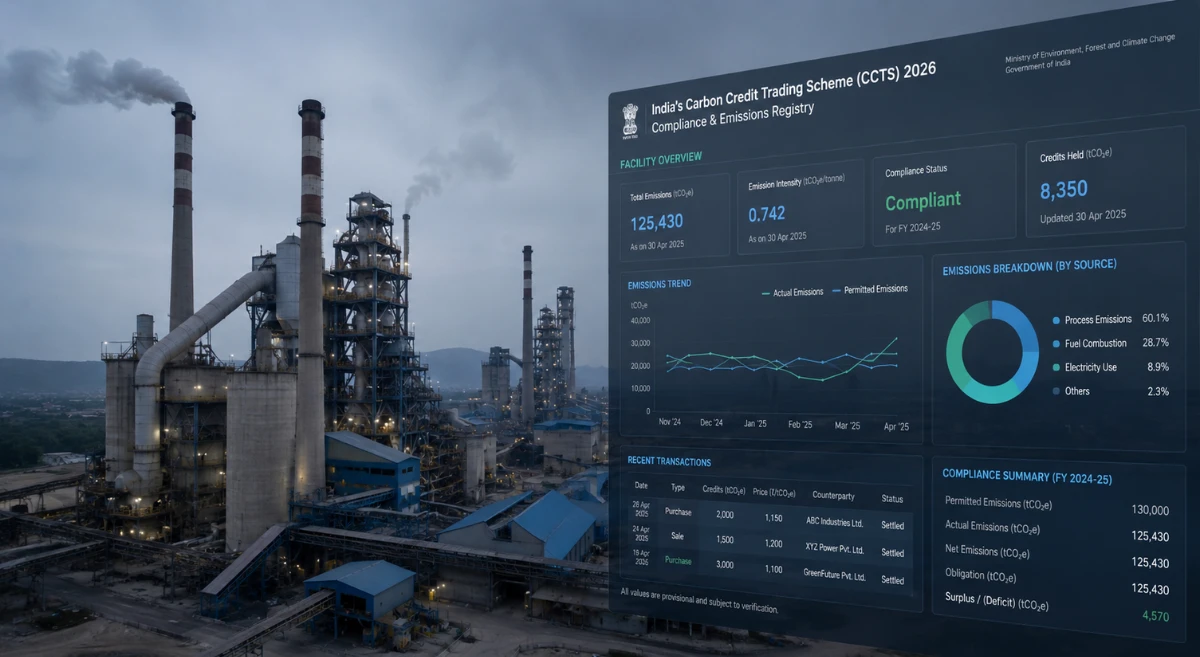
India's Carbon Market Goes Live: 490 Industrial Units Face Binding Targets as CCC Trading Nears
India's first mandatory carbon trading system has moved from policy architecture to active compliance. The question now is whether the market infrastructure can handle the weight placed on it.
As of 1 April 2025, the starting date of India's fiscal year 2025-26, approximately 490 industrial units across seven energy-intensive sectors have been operating under legally binding greenhouse gas emission intensity targets. The Carbon Credit Trading Scheme India's first mandatory emissions trading system is no longer a pipeline announcement. Compliance obligations are in force. The first Carbon Credit Certificate trading window is expected to open by mid-2026.
What the CCTS Is and How It Works
The CCTS operates as an intensity-based baseline-and-credit system. Unlike a hard cap system that sets an absolute ceiling on total emissions, it assigns each covered entity a target defined as tonnes of CO2 equivalent per unit of output. Companies that produce goods more efficiently than their assigned benchmark earn Carbon Credit Certificates, which they can sell on India's power exchanges. Those that fall short must purchase and surrender an equivalent number of certificates to meet compliance.
Targets were notified in two phases. The Ministry of Environment, Forest and Climate Change notified the first four sectors aluminium, cement, chlor-alkali, and pulp and paper in October 2025. Petroleum refining, petrochemicals, and textiles followed in January 2026. All targets use fiscal year 2023-24 as the baseline and apply to the compliance years 2025-26 and 2026-27. Critically, compliance obligations apply retroactively: the first compliance date for FY2025-26 is 31 July 2026. Two sectors — iron and steel, and fertilizer — are still awaiting final target notification.
The Market Infrastructure Now in Place
The operational backbone of the Indian Carbon Market was formally launched on 21 March 2026, when Power Minister Manohar Lal Khattar inaugurated the Indian Carbon Market Portal at the Prakriti 2026 International Conference on Carbon Markets in New Delhi. The portal enables entity registration, third-party monitoring, reporting and verification, and Carbon Credit Certificate issuance. Grid-India functions as the registry. The Central Electricity Regulatory Commission acts as trading regulator, with Carbon Credit Certificates to be traded on existing power exchanges.
The system also includes an Offset Mechanism for voluntary participants outside the nine notified sectors. As of the Prakriti 2026 conference, nine offset methodologies had been approved across five sectors including biogas, hydrogen, and forestry, with over 40 entities already registered or submitting projects.
Why This Matters for Indian Industry
The immediate commercial implication is straightforward: covered entities face a financial cost if they underperform their GHG intensity benchmarks and a revenue opportunity if they overperform. For the seven sectors currently under compliance, this is not a future planning exercise. The compliance period started more than a year ago.
The CCTS carries an additional dimension that gives it strategic weight beyond domestic policy. The European Union's Carbon Border Adjustment Mechanism began applying charges on imports from 2026. Indian exporters in cement, steel, aluminium, and fertilizers — sectors with substantial EU export exposure — now have a direct incentive to demonstrate domestic carbon pricing as a shield against paying that charge to European authorities. A credible domestic carbon price reduces the CBAM liability. Without it, that cost sits entirely with the exporter.
The Gaps That Still Need Closing
The CCTS's design, while workable for a rapidly industrialising economy, carries structural limitations that the market will test in its first trading cycle. The intensity-based approach means total emissions can rise as long as they scale with output a meaningful constraint on the system's absolute mitigation impact. Final targets for iron and steel and fertilizer remain unnotified, leaving two of India's most emissions-intensive sectors outside the compliance framework for now.
High financing costs identified by the IEA as a structural drag on India's clean transition also apply here: companies that need to invest in efficiency upgrades to avoid CCC shortfalls will face the same capital access constraints as the broader energy transition.
What to Watch
- Whether the first CCC trading window opens on schedule in mid-2026, and at what price Carbon Credit Certificates discover on the power exchanges the initial price signal will define market credibility.
- Notification of GHG intensity targets for iron and steel, India's largest industrial emitter, which would significantly expand the CCTS coverage footprint.
- How Indian exporters in covered sectors are incorporating CCTS compliance into their EU CBAM filing strategies for 2026 reporting cycles.