Solar PV Up 25% Annually, Transmission at $26 Billion: Inside India's Record Energy Investment Year
As solar PV compounds at 25% annually and transmission spending crosses $26 billion, the IEA's latest report reveals a clean energy system pulling ahead of its own infrastructure.
India's total energy investment is on course to reach $170 billion this year, the highest in the country's history, according to the International Energy Agency's World Energy Investment 2026 report, published Thursday. The figure, which has grown at an average 11% annually over the past five years, reflects a power sector undergoing a genuine structural reorientation, with capital flowing to solar, grid infrastructure, and storage at a pace that has materially altered the ratio of clean to fossil spending.
The number that defines the shift is not the headline total. It is the ratio: India now invests approximately $3 in renewable and nuclear power for every $1 directed at fossil-fuel-based generation. Five years ago, that ratio stood at 1.5 to 1. The IEA report positions this as one of the most consequential changes in how a major emerging economy allocates capital across its energy system, with investments in coal-fired generation falling to less than 40% of their 2010 peak, even as coal itself retains a dominant role in actual power output.
Solar and Grid Drive the Growth
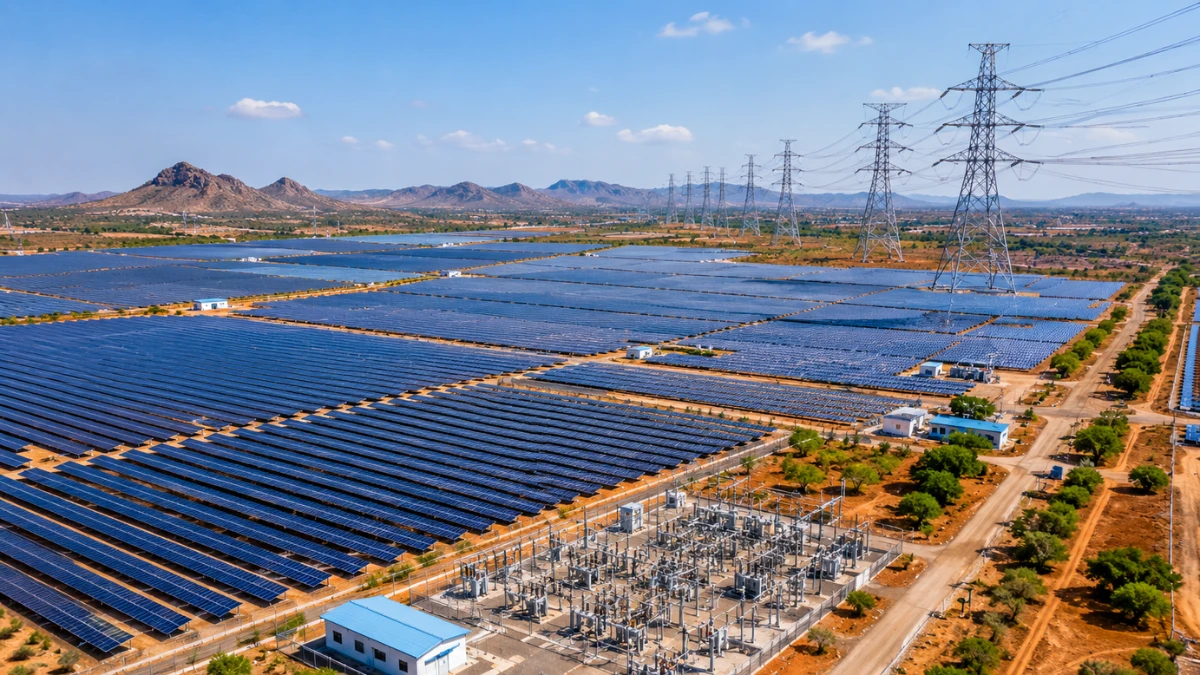
Solar PV is the headline performer. Investment in photovoltaic projects has compounded at 25% annually since 2020, with solar and wind together now accounting for over half of India's total installed capacity. That share, once a target, is now a floor. The clean energy buildout has expanded fast enough that the constraint is no longer generation capacity but the infrastructure required to move that power to where demand exists.
Transmission and distribution investment is projected to reach $26 billion in 2026, itself growing at 15% annually over the past five years. The Green Energy Corridor programme, designed to connect renewable-rich regions to national and state grids, has added over 3,000 km of new lines under its first phase. Subsequent phases are underway. Yet the IEA flags grid upgrades as a continuing priority, noting that India's electricity grid is expanding at a pace slower than the boom in renewable installations, creating a curtailment risk that limits the effective output of already-commissioned capacity.
The Coal Ledger
The IEA report does not allow the $170 billion figure to read as a clean energy story in isolation. India is identified as the world's second-largest investor in coal supply, with coal-related capital outlays tripling over the past decade and expected to reach $13 billion in 2026 as the government targets an increase in domestic coal production from roughly 1 billion tonnes to 1.5 billion tonnes by 2030. Upstream oil and gas investment, by contrast, has contracted at an average 7% annually since 2020, prompting a new licensing regime intended to reverse the decline.
The coexistence of surging solar investment and rising coal supply spending is not a contradiction unique to India. It reflects the structural reality of a rapidly industrialising economy adding electricity demand faster than any single source can serve, while simultaneously pursuing long-term decarbonisation commitments under its updated Nationally Determined Contribution, which targets a 47% reduction in emissions intensity by 2035.
What the Capital Stack Tells Investors
The composition of the $170 billion matters as much as the total. Power sector investment accounts for roughly half of all energy spending. Within that, the clean-to-fossil ratio shift signals where private capital is finding regulatory and policy support. The EV investment figure, at $2 billion and roughly 5% of total vehicle sales, indicates that India's transport electrification story, while growing, has not yet reached the inflection point that the power sector has.
The grid gap is the variable that most directly shapes near-term investment opportunity. With curtailment rising as renewable capacity outpaces transmission, the financial case for storage, grid modernisation, and dispatchable power sources is strengthening independently of new policy mandates. Hybrid tenders, pumped storage, and nuclear are all expanding, according to the IEA, supported by policy reforms and new market mechanisms.
What to Watch
- Whether the second and subsequent phases of the Green Energy Corridor programme receive accelerated funding commitments in 2026, given the IEA's explicit flag on grid constraints as the primary bottleneck to realising India's renewable investment.
- The pace at which battery storage investment scales alongside solar PV, and whether domestic manufacturing under the PLI scheme reduces the cost gap that has kept storage deployments below the level transmission planners require.
- How the IEA's framing of India as the world's second-largest coal supply investor shapes multilateral climate finance negotiations, particularly in the context of India's 2035 NDC targets and ongoing discussions around Just Energy Transition Partnerships.