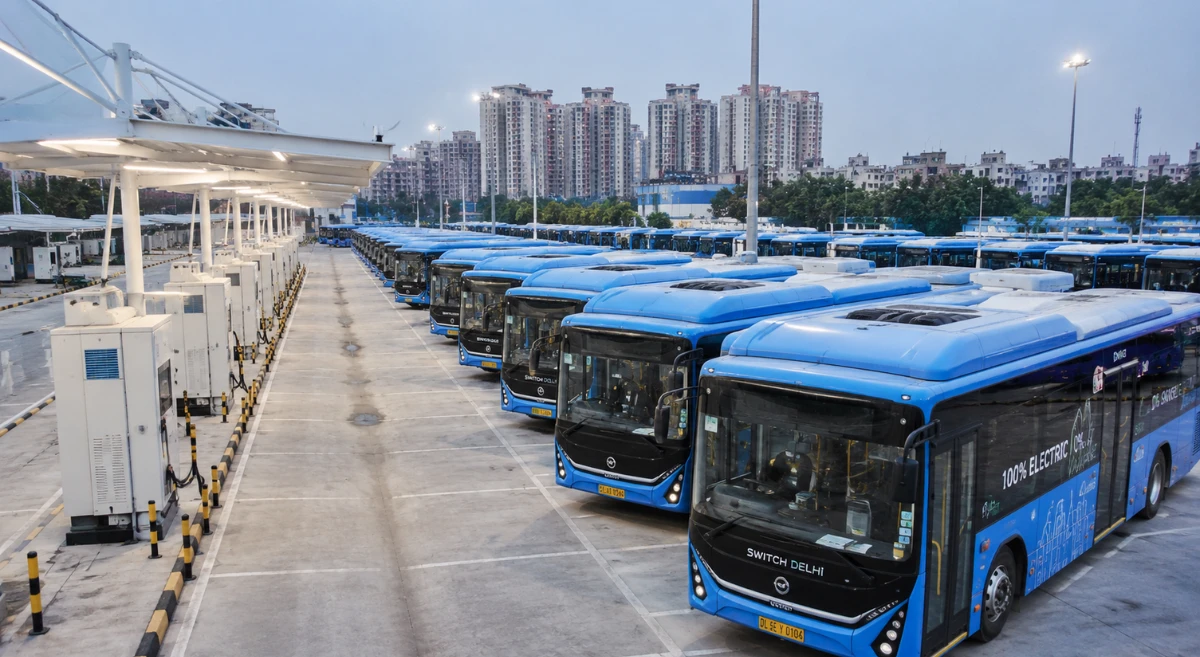
KKR Acquires Majority Stake in Allfleet as India's Electric Bus Market Draws Its Largest Climate Transition Investment
The platform model combining manufacturing, ownership, operations, and lifecycle support under one roof is designed to remove the barriers that have historically kept electric buses from scaling in Indian cities.
KKR has committed up to $310 million to form a strategic partnership with Allfleet India and its parent company PMI Electro Mobility Solutions, acquiring a majority stake in Allfleet and a minority stake in the manufacturing business. The transaction, announced in March 2026 and expected to close in mid-2026 subject to regulatory approvals, marks KKR's first deployment under its Global Climate Transition strategy in India, and the strategy's eighth investment globally since its launch in August 2023.
What the Platform Actually Does
Allfleet was established in 2022 as PMI Electro's dedicated fleet ownership and operations vehicle. Where PMI Electro manufactures the buses, Allfleet develops, owns, and operates them under long-term concession and service agreements with state transport authorities. The model bundles fleet management systems, maintenance, and lifecycle support alongside the vehicles themselves, removing the need for municipal transport bodies to carry capital expenditure or operational risk on their own balance sheets.
PMI Electro has already deployed more than 3,000 electric buses across over 30 Indian cities, offering 7-metre, 9-metre, and 12-metre configurations alongside electric school buses. Allfleet is on course to deploy more than 5,000 buses in total under its existing concession pipeline. KKR's capital is intended to accelerate that rollout and strengthen PMI Electro's manufacturing capacity to support it.
Why the Investment Structure Matters
The integrated platform model is the strategically significant element here, not the headline number alone. India's electric bus rollout under the PM e-Bus Sewa scheme and its predecessors has been chronically constrained not by policy ambition but by execution: state transport undertakings lack the balance sheet to purchase fleets outright, while manufacturers have limited appetite to carry fleet ownership risk themselves. The result has been a gap between bus sanctions and actual deployments that has persisted for years.
The Allfleet model addresses that gap by separating bus ownership from bus operation, allowing municipalities to access electric public transport without upfront capital commitment. KKR's entry brings both the financial depth to hold assets at scale and global operational experience from its broader climate transition portfolio, which has committed more than $44 billion to climate and environmental sustainability investments since 2010.
India's Urban Transport Decarbonisation at Stake
India's cities face a compounding challenge: urban populations are growing, road congestion is worsening, and diesel bus fleets which remain the backbone of public transport across most Indian cities are a significant and largely unaddressed source of urban air pollution and transport-sector emissions. The electric bus pipeline exists on paper; the execution infrastructure to deploy it at speed has been the missing piece.
The commercial model KKR is backing reflects a broader shift in how climate capital is being deployed in India. Rather than financing individual assets, it is financing the platform infrastructure that allows assets to be deployed repeatedly and at lower marginal cost. That distinction matters for investors evaluating replication risk and for policymakers assessing which models deserve continued regulatory and procurement support.
The Questions This Deal Does Not Yet Answer
The transaction's scale and structure are credible. What remains to be demonstrated is whether the concession model can sustain returns at the tariff levels that state transport authorities are willing and able to pay. India's public transport pricing is politically sensitive, and long-term concession agreements with state bodies carry renegotiation and counterparty risk that private capital has historically found difficult to price accurately in Indian infrastructure deals.
PMI Electro registered 1,041 electric bus unit sales in 2025, up from 534 in 2024 — growth that reflects genuine market momentum but also a base that remains modest relative to the 5,000-bus target. The pace of concession award and commissioning will be the operational test that validates or challenges the platform thesis.
What to Watch
- Formal transaction close confirmation in mid-2026 and the regulatory approvals required, particularly from Competition Commission of India.
- The pace of new concession agreements signed with state transport authorities following KKR's capital injection, as a measure of whether the investment accelerates or simply consolidates the existing pipeline.
- Whether the Allfleet model attracts replication from other electric bus manufacturers and fleet operators, or remains a standalone platform in a market that has yet to standardise its financing structure.