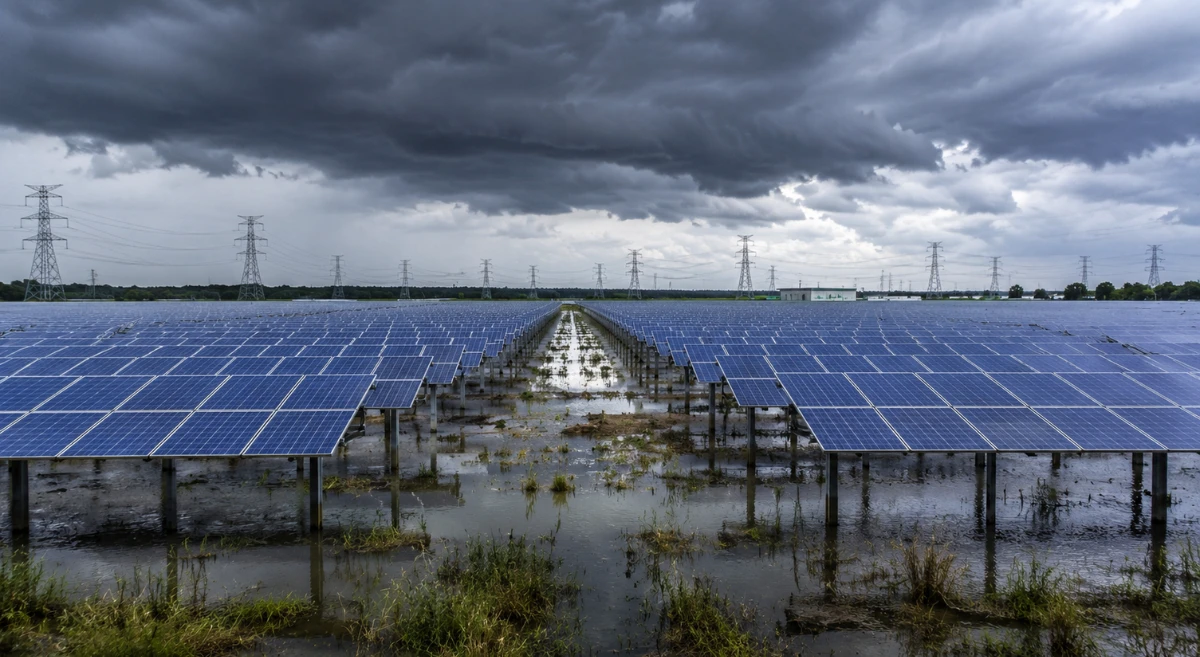
A 2% Capex Fix Could Save India's Renewable Sector USD 28 Billion in Climate Losses
India's renewable energy expansion is moving fast enough to attract global capital and fast enough to outpace the climate risk frameworks that protect it.
Nearly 90% of India's planned renewable energy capacity faces high or critical exposure to physical climate hazards by 2030, according to a report released on 25 June 2026 by Zurich Kotak General Insurance and Zurich Resilience Solutions, the risk advisory arm of Zurich Insurance Group. The assessment estimates that approximately USD 55 billion in renewable energy assets could be exposed to climate-related losses if resilience measures are not built into projects during the design and construction phase.
The study evaluated 871 planned renewable energy sites across ten states and union territories, representing roughly 90% of India's active development pipeline — around 239 GW of solar, wind, and hydropower capacity. Its core finding for project financiers and developers is quantified: allocating approximately 2% of project capital expenditure to climate resilience measures at the planning and construction stage could reduce projected losses by nearly half, from USD 55 billion to USD 27 billion. That translates to an estimated USD 28 billion in avoided losses, or a sixfold return on the resilience investment.
What the Hazard Profile Looks Like
The report identifies four primary hazard categories driving the bulk of projected losses: tornado, wildfire, flood, and hail. Each maps directly to physical damage mechanisms civil works failure, substation damage, module degradation, mounting system stress, and prolonged operational disruption. The report notes that by 2030, 66% of the assessed pipeline is projected to sit in the top two risk bands, Categories 4 and 5, meaning a 15% to 30% probability of experiencing a major climate event within the asset's operational life.
Geography concentrates risk unevenly. Arunachal Pradesh and Uttarakhand showed the highest share of projects in critical-risk categories — both states with significant hydropower pipelines in geologically active, flood-prone terrain. Gujarat and Rajasthan, which together account for a dominant share of India's large-scale solar pipeline, also recorded material exposure levels, primarily from hail and extreme heat affecting module performance and mounting integrity.
Solar energy projects account for the largest share of exposed capacity, representing around 182 GW of the assessed 239 GW pipeline.
Why This Matters for Capital
India became the world's third-largest holder of renewable energy capacity in 2026, with installed non-fossil capacity reaching 283.5 GW by March, according to the report. Renewable generation is expanding at approximately 11% annually. The investment requirement to reach the 500 GW non-fossil target by 2030 is substantial, and a growing share of that capital is coming from private equity, infrastructure funds, and multilateral development banks operating with explicit asset protection mandates.
The Zurich Kotak findings introduce a material consideration into that capital stack. An asset that is cheaper to build because resilience measures were skipped is not necessarily cheaper to own, insure, or refinance over a 25-year power purchase agreement lifecycle. Ajey Hegde, Head of Commercial Insurance at Zurich Kotak General Insurance, noted that building resilience from the outset can protect investment value, improve insurability, and give lenders and investors greater confidence in long-term performance. For project developers operating on compressed tariff margins the latest SECI solar-plus-BESS tranches cleared at ₹2.86/kWh — the 2% capex premium for resilience measures may represent the difference between a bankable and an unbankable asset from a lender's perspective.
The Structural Gap the Report Identifies
The timing of the report is deliberate. Many of the 871 assessed projects are still in planning or early construction, meaning the window to embed resilience measures — when engineering flexibility is greatest and cost is lowest — remains open. The report's practical recommendations include making forward-looking climate risk screening mandatory at planning and permitting stage, stress-testing the highest-risk assets first, embedding hazard-specific requirements into procurement standards, and treating system resilience — grid infrastructure, access roads, communications — as inseparable from asset resilience.
The report also flags a methodological issue that applies beyond India: historical climate baselines are no longer sufficient for assets expected to operate into the 2050s and beyond. Projects designed against 20th-century hazard data carry structural underestimation of exposure.
What to Watch
- Whether MNRE or the Central Electricity Authority incorporates forward-looking climate hazard screening into project approval or permitting frameworks — currently neither requires it.
- How lenders and multilateral development banks respond to the quantified risk exposure: an explicit 6x ROI on resilience investment is the kind of framing that finds its way into loan covenant and due diligence requirements.
- Whether insurance penetration in India's renewable sector increases as a result — currently most large-scale solar and wind projects carry limited physical damage cover relative to their asset value.