Eight Times the Capital in Five Years: India's Climate-Tech Sector Reaches an Inflection Point
Cumulative equity funding has crossed $12.8 billion. The question is no longer whether India's climate economy is real, it is whether the policy scaffolding can keep pace with investor appetite.
India's climate-technology sector has raised $12.8 billion in cumulative equity funding across 2,770 rounds, according to the Tracxn India Climate Tech 2026 report released on 4 June. The figures cover 1,583 funded companies and 104 recorded exits as of June 3, 2026.
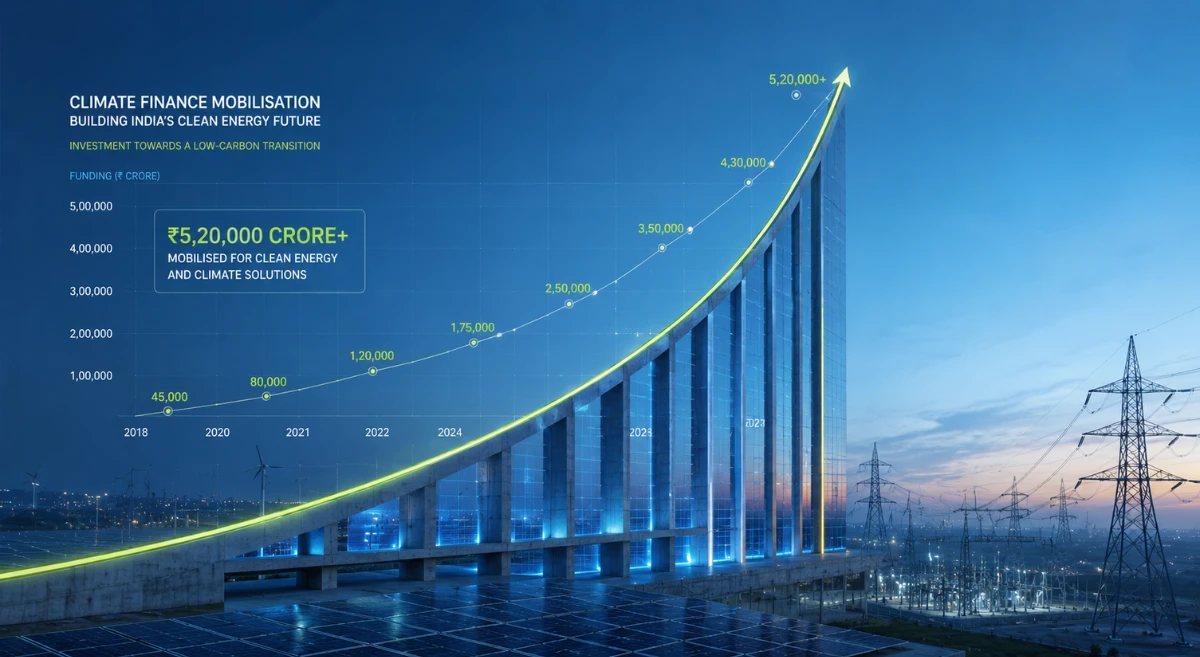
The headline number, taken alone, is significant. The context behind it is more so. Annual funding in the sector has grown from approximately $315 million in 2020 to $2.6 billion in 2025 roughly an eightfold increase over five years. That trajectory is not driven by a single outsized deal or a momentary surge in risk appetite. It reflects a compounding of factors: improving unit economics across solar and electric mobility, a policy environment that has moved from aspiration to enforcement, and a growing investor recognition that energy security and decarbonisation are converging objectives for India rather than competing ones.
Renewable Energy Leads, But the Stack Is Diversifying
Renewable Energy Tech is the largest climate-tech segment by cumulative funding, having attracted $1.5 billion across 195 rounds. Notable transactions include Inox Clean Energy's $344 million Series D and $70 million Series C. Electric mobility, anchored by Erisha E Mobility's $1 billion Series D in 2025, has been the most visible driver of headline deal volume.
Beyond these two lead segments, the funding distribution tells a more nuanced story. Solid Waste Management Tech has raised $477 million, followed by Energy Efficiency Tech at $352 million, Air Pollution Management Tech at $237 million, and Water and Wastewater Management Tech at $208 million. Together, these segments account for roughly $1.3 billion of the cumulative total a figure that signals the climate-tech investment thesis is widening beyond clean power generation into the broader infrastructure of decarbonisation.
Within energy efficiency, companies such as 75F (which secured a $45 million Series B) and Applied Energy ($40 million Series D) have attracted institutional capital. In air pollution management, Chakr Innovations closed a $23 million Series C. These are not symbolic investments. They reflect a commercially grounded view that India's industrial and urban transition requires solutions across the full emissions stack, not only at the generation end.
Policy as the Structural Variable
The report identifies government policy as a primary driver of investor confidence, and the specific schemes it cites are worth examining precisely. The PM E-DRIVE programme, extended until 2028 with a Rs 10,900 crore outlay, is creating demand visibility for companies operating across the electric vehicle and battery ecosystem. The Carbon Credit Trading Scheme, scheduled to begin its first compliance trading cycle in October 2026, will establish price signals across nine energy-intensive industrial sectors covering approximately 490 entities. The Rare Earth Permanent Magnets scheme, backed by Rs 7,280 crore, targets domestic supply chain development in a segment where import dependency is both a cost and a security vulnerability.
What connects these three policy instruments is their underlying logic: each converts a previously discretionary market behaviour, EV adoption, emissions reduction, domestic input sourcing into a regulated or incentivised obligation. For investors, that conversion reduces demand uncertainty and extends the investable horizon.
The Gap Between Capital and Deployment
The $12.8 billion figure is cumulative and covers a sector defined broadly. Against India's total clean energy investment requirement estimated by the IEA at $170 billion in 2026 alone across the full energy system climate-tech venture and growth equity remains a relatively narrow slice. The sectors attracting the most capital, renewable energy and electric mobility, are also the ones with the clearest policy tailwinds and the most liquid exit pathways. Segments such as carbon accounting, industrial energy efficiency for small and medium enterprises, and green hydrogen remain underfunded relative to their stated policy priority.
With 85% of India's crude oil requirements met through imports, the government has framed clean energy investment explicitly as an energy security imperative, not merely a climate commitment. That framing matters for capital allocation: it broadens the investor base beyond ESG-mandated funds to include infrastructure capital, sovereign wealth, and industrial conglomerates.
What to Watch
The October 2026 launch of compliance trading under the Carbon Credit Trading Scheme will be the first real test of whether India's carbon market can generate price signals sufficient to shift industrial investment decisions and whether the voluntary offset mechanism can channel capital toward smaller, harder-to-finance climate projects.
Watch whether annual climate-tech funding sustains the $2.6 billion 2025 level in 2026, or whether the West Asia-driven macroeconomic uncertainty that has compressed startup funding broadly affects climate-tech deal flow in H2.
Track whether the segments that remain underfunded relative to policy priority, green hydrogen, SME energy efficiency, climate adaptation infrastructure begin to attract dedicated vehicles or whether capital continues to concentrate in the renewable energy and EV segments where return visibility is highest.
Source: Tracxn India Climate Tech 2026 Report · 4 June 2026