A Defining Year for India’s Energy Transition
India’s energy story this year is not about a single breakthrough—it is about convergence.
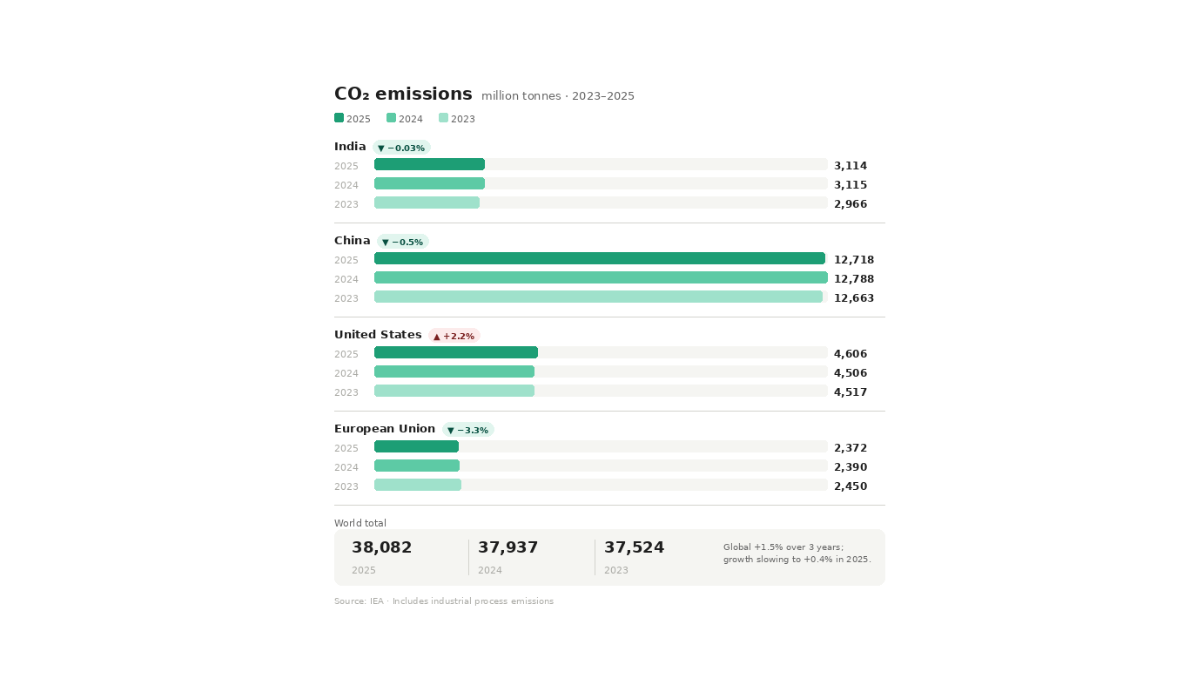
An unusually strong monsoon and an accelerated scale-up in solar capacity have together altered the country’s emissions pathway. The result is not a decline in absolute emissions, but something equally important: a visible slowdown in emissions growth relative to economic expansion. Data from the International Energy Agency reinforces this shift. While global emissions continue to edge upward, India is beginning to bend its curve - subtly, but structurally.
Hydro as a Shock Absorber
The monsoon acted as a short-term stabilizer. Higher-than-average rainfall pushed reservoir levels to capacity, enabling sustained hydroelectric output. This reduced the need for coal-fired generation during peak demand periods—particularly when cooling loads typically drive fossil fuel use. The impact was immediate but temporary: lower coal dispatch, reduced marginal emissions, and a cleaner grid mix during critical months. However, this was not transformation. It was cushioning.
Solar as the Structural Driver
The underlying shift is being driven elsewhere. India’s solar expansion over the past year has exceeded expectations—both in utility-scale installations and distributed rooftop adoption. More importantly, solar is beginning to change the operating logic of the grid. It is no longer supplementary. It is increasingly foundational. As hydro output tapered post-monsoon, solar generation sustained the reduction in coal dependency. This sequencing—hydro-led relief followed by solar-led continuity—signals a system that is beginning to rebalance. This is what a structural transition looks like: when gains persist beyond favorable conditions.
Decoupling, in Early Form
The global comparison is instructive:

India’s emissions continue to rise. But the rate of increase is slowing relative to GDP growth—indicating a decline in emissions intensity. This is early-stage decoupling. In contrast, many advanced economies are seeing emissions reductions plateau amid political resistance and infrastructure constraints. India, by comparison, is building capacity while still growing—compressing what has historically been a sequential transition into a parallel one.
Constraints Remain
The shift is real, but incomplete. Coal continues to underpin India’s industrial base and grid stability. Storage deployment remains limited. Transmission infrastructure will need to scale in step with renewable capacity.
Without parallel investments in grid flexibility, the pace of solar integration could outstrip system readiness.
What This Signals
India’s trajectory offers a different template for the energy transition:
- Use natural variability (like strong monsoons) as temporary accelerators
- Build structural capacity (solar) to lock in gains
- Reduce emissions intensity before absolute emissions peak
This is not a linear transition. It is layered.
Climate Watch Take
India is not yet reducing emissions - but it is changing the direction of travel. The significance lies in the shift from episodic gains to sustained momentum. When clean energy capacity begins to carry forward the benefits of favorable conditions, the transition moves from reactive to structural. That shift now appears underway. The question is no longer whether India can scale renewables—it is whether the broader system can keep up.
Source of Data : IEA