El Niño's Return Puts India's Solar Irradiance on Track for a 10–15% Boost
As a developing El Niño event strengthens toward year-end, solar project operators and grid planners in India are sitting on a potential yield windfall, but the same climate pattern that benefits India will subtract from assets in South America and East Asia.
What Is Happening
A new El Niño event has been formally declared. Sea surface temperatures in the central Pacific's Niño 3.4 region have exceeded 0.8°C above the long-run average, satisfying the threshold criteria used by major meteorological agencies. Seasonal forecast models, including analysis published by Solcast, a DNV company, indicate the event is expected to intensify through the Northern Hemisphere winter of 2026–27, with its peak likely toward year-end.
The event has direct implications for solar resource globally. Based on historical patterns from past strong El Niño events during the July–to–September window, Solcast's analysis identifies clear regional divergences in irradiance: significant gains across most of India, eastern Australia, equatorial Africa, and parts of Central America; and measurable reductions across western and southern South America and parts of East Asia, including eastern China.
India's Solar Advantage
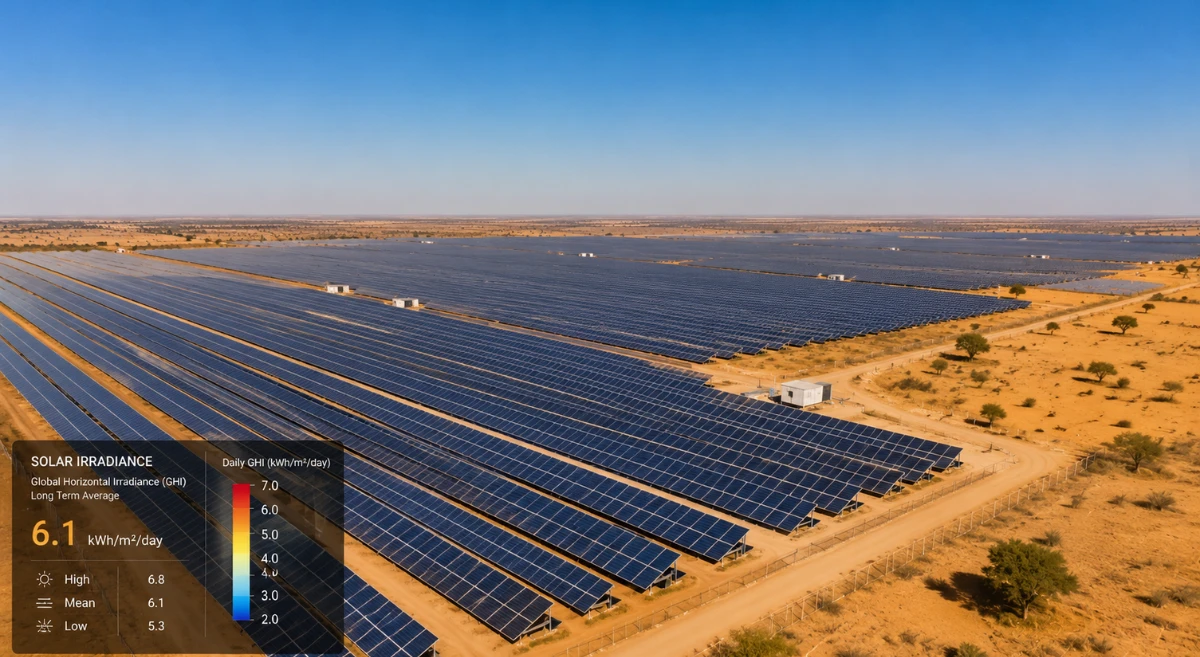
India sits among the clearest beneficiaries in historical El Niño records. Across past strong events, much of India recorded irradiance up to 10% above multi-year averages. Rajasthan, the country's dominant large-scale solar development corridor and home to some of the world's largest photovoltaic installations, showed even stronger gains: irradiance around 15% above normal in comparable periods.
The mechanism is atmospheric. El Niño suppresses the cloud cover and rainfall patterns that would otherwise reduce available solar resource across the subcontinent. When the Pacific warms, large-scale circulation shifts redirect cloud formation away from northwest India, precisely the geography where grid-scale solar capacity is most heavily concentrated.
For project owners and power purchase agreement counterparts, this is a meaningful operating variable. A sustained 10–15% irradiance uplift over a quarter translates directly into above-contracted generation, positive deviations against P50 yield estimates, and, for merchant exposure, incremental revenue at spot prices.
The Other Side of the Ledger
The Solcast analysis is explicit that El Niño redistributes solar resource rather than creating net global gains. Western and southern South America, which hosts a growing portfolio of utility-scale solar in Chile and Peru, recorded irradiance around 10% below normal during comparable historical events. Parts of East Asia — including eastern China, one of the world's largest solar markets by installed capacity — showed weaker but consistent reductions driven by increased cloud cover and rainfall.
For global portfolio managers and equipment manufacturers with cross-regional exposure, the asymmetry matters. A project developer optimising asset acquisition or financing in 2026 faces meaningfully different yield risk profiles depending on geography — not because of project-level factors, but because of where the Pacific's heat reservoir is sitting.
The Forecast Uncertainty
Solcast's framing is appropriately conditional. Regional irradiance impacts from El Niño carry site-level variation, shaped by how large-scale circulation changes interact with local topography, proximity to moisture sources, and other concurrent climate drivers such as the Indian Ocean Dipole. The 10–15% figures represent historical central tendencies for the region, not guaranteed outcomes for individual assets.
The event is also still developing. NOAA's Climate Prediction Center confirmed El Niño conditions in June 2026, with continued strengthening expected. The magnitude of irradiance effects will depend on how strongly the event peaks — a moderate event would produce smaller departures than the historical strong-event averages that underpin Solcast's regional mapping.
What to Watch
- Whether MNRE or grid operators integrate ENSO-based irradiance forecasts into India's short-term renewable generation scheduling, given the material impact on grid balancing at scale.
- How lenders and independent engineers assess the 2026 yield year in project finance reviews — above-P50 performance driven by El Niño is a one-time climate event, not a structural upward revision to long-term resource assumptions.
- The performance divergence between Indian and Chilean or Chinese solar assets in H2 2026 reporting, which will offer a live test of the Solcast historical pattern analysis.