Power, MNRE and Heavy Industries Hold Joint Review as India's Storage Gap Pushes Evening Spot Prices to Rs 20 Per Unit
As India's generation capacity races toward its 2030 targets, the infrastructure built to move that power is falling further behind, and the economic cost is now visible in real time.
India's Renewable Surplus Has Become a Grid Problem
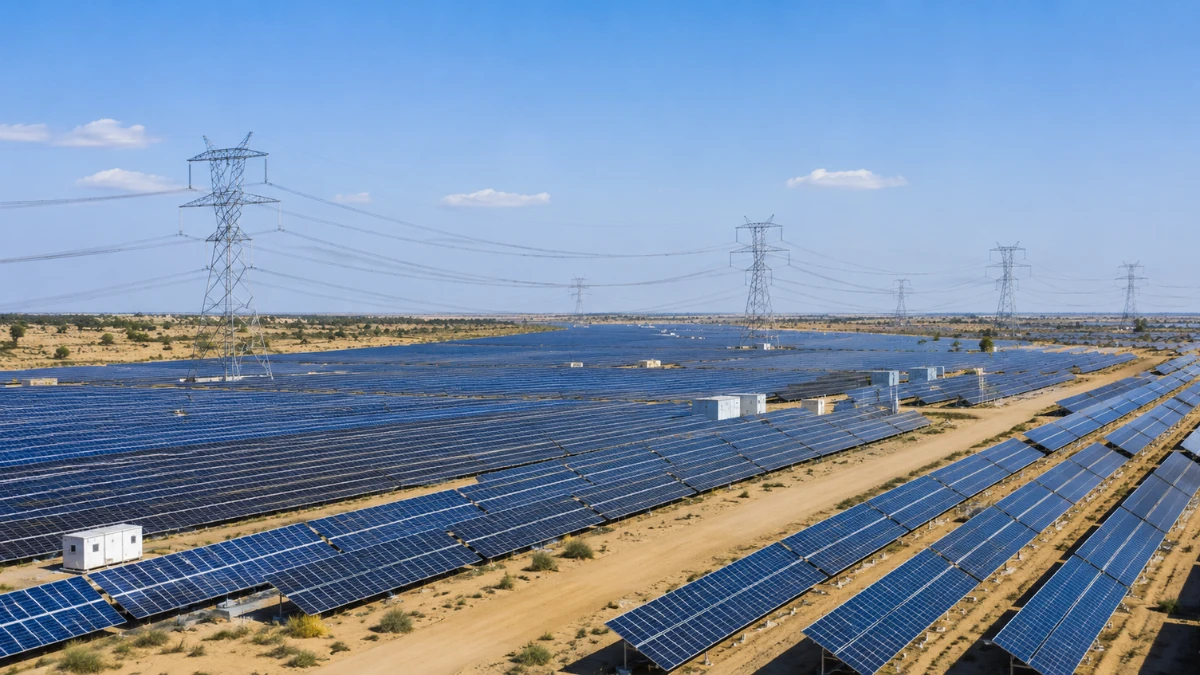
The numbers make the tension plain. India now operates over 520 GW of total installed generation capacity, with more than half sourced from non-fossil fuels. Yet in the January-March 2026 quarter alone, the country curtailed 31 GW of renewable energy — power that was generated but could not be delivered because the transmission network and storage systems were not in place to absorb it. That figure, reported by the Centre for Research on Energy and Clean Air, is not a rounding error. It represents a structural mismatch between what India can generate and what its grid can actually use.
The economic signal arrived alongside it: evening spot power prices climbed to Rs 20 per unit in recent weeks, driven by a sharp demand spike after solar generation tapers off and a near-absence of storage capacity to bridge the gap. With India's installed battery energy storage system (BESS) capacity currently at just 0.27 GW against a Central Electricity Authority (CEA) target of 80 GW by 2035-36, the gap between ambition and operational reality is difficult to overstate.
Three Ministries, One Urgent Agenda
On 13 May, the Ministries of Power, New and Renewable Energy, and Heavy Industries convened a joint meeting to confront the problem directly. Power Minister Manohar Lal described the session's intent as taking "decisive steps towards maximising renewable energy utilisation and building a smarter, greener power ecosystem."
Three specific issues were on the table.
The first was BESS deployment. Experts attending the meeting argued that energy storage rollout must be accelerated in step with renewable capacity addition, not treated as a downstream problem. Storage is now a prerequisite for grid reliability, not an enhancement: without it, solar generation that cannot be dispatched in the evening peak is simply wasted. The CEA projects that India will need 174 GW and 888 gigawatt hours (GWh) of total energy storage by 2035-36, split between 80 GW of BESS and 94 GW of pumped hydro. Getting from 0.27 GW to 80 GW in under a decade is a procurement, financing, and manufacturing challenge of a different order than anything India has executed in the storage sector before.
The second was transmission. A series of critical grid projects have faced delays, contributing directly to the curtailment problem. Rajasthan and Gujarat, India's two largest renewable generation states, are geographically distant from major load centres. Without inter-regional high-voltage corridors, power generated in the Thar Desert has limited routes to reach industrial and urban demand in the east and south. The CEA has estimated that India will need 137,500 additional circuit kilometres of transmission lines and roughly Rs 7.9 trillion in grid investment by 2035-36 to meet its capacity targets. The ministries reviewed the pipeline of critical transmission projects and discussed mechanisms to accelerate their execution.
The third was demand-side management through time-of-day (ToD) tariffs. This is a pricing mechanism that charges higher rates during evening peak hours and lower rates during midday solar abundance, incentivising industrial consumers and large commercial users to shift discretionary load into solar hours. If implemented at scale, ToD tariffs could reduce curtailment without requiring new infrastructure, by reshaping when demand occurs rather than where power flows. The policy is not new, but its implementation has remained patchy across state DISCOMs.
The Commercial Stakes
The implications of the curtailment problem extend well beyond grid operations. For renewable energy developers, curtailment reduces effective generation revenue and complicates the financial models that underpin project finance. Power purchase agreements priced on the assumption of near-full utilisation become less bankable when 31 GW of capacity is regularly unavailable to the grid. For BESS manufacturers and developers, the ministerial meeting represents a demand signal: the government is under pressure to accelerate procurement, which means more tenders, potentially faster VGF disbursals, and a push to bring domestic storage manufacturing to scale under existing PLI frameworks.
For corporate clean energy buyers, the storage and transmission bottleneck is a practical risk. Open-access renewable procurement agreements depend on reliable evacuation infrastructure. Where that infrastructure is absent or congested, delivery commitments are harder to guarantee.
What to Watch
The ministerial meeting was a review, not a policy announcement. The near-term indicators to track are: whether pending critical transmission projects receive accelerated environmental or land clearance; whether the Ministry of Power issues revised guidelines on VGF disbursement timelines for BESS; and whether ToD tariff implementation receives a central directive to states rather than remaining advisory. The CEA's 2035-36 storage target — 888 GWh — is technically achievable, but only if procurement moves from discussion into commissioning at a pace that has not yet been demonstrated. The curtailment data suggests the cost of delay is already being paid.