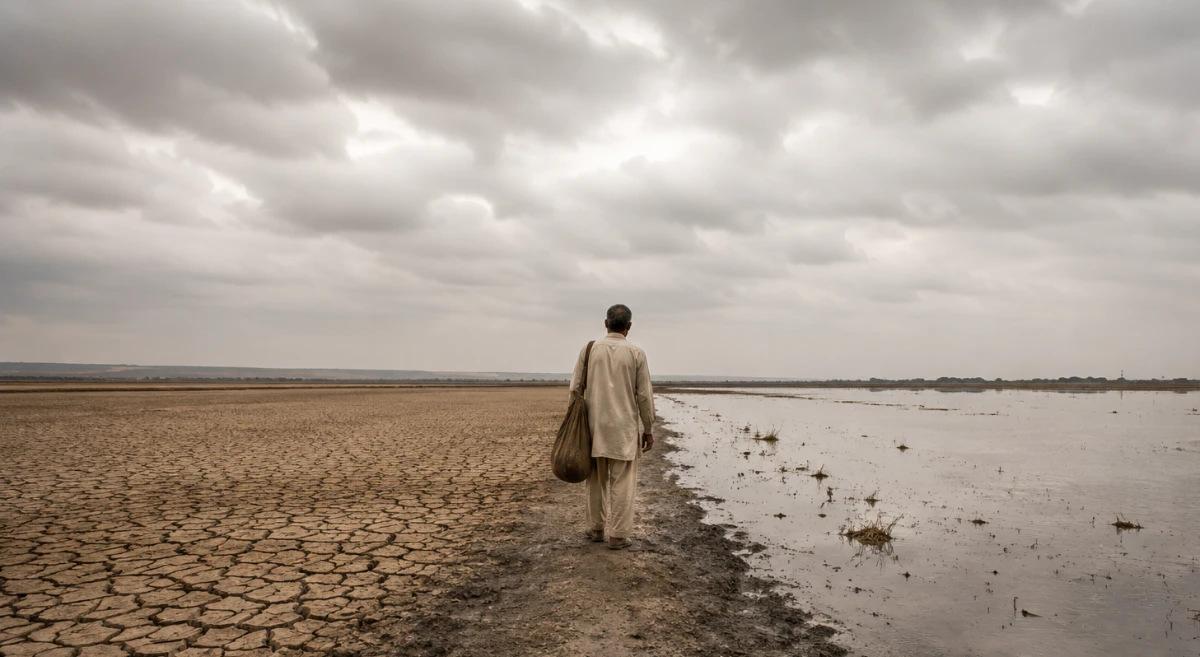
70,000 people displaced by extreme weather every single day.
On World Refugee Day, a landmark UNHCR report reveals that three in four displaced people now live in countries facing extreme climate hazards. The crisis has a compounding logic — and it demands a rethink of how the world responds.
No Safe Ground to Return To
Picture returning home after years of displacement only to arrive in a landscape scorched by drought, swept by flood, or rendered unworkable by heat so extreme your body can't cool itself. This is not a hypothetical. In early 2025, 1.2 million refugees returned home but half arrived back in areas classified as climate-vulnerable. For millions of people, the journey home leads directly into a second emergency.
World Refugee Day, observed every 20 June, has historically centred on conflict and persecution. But the science is now unambiguous: climate change has become a co-driver of global displacement, compounding existing crises and foreclosing recovery pathways for the most vulnerable communities on Earth.
The Scale of a Compounding Crisis
By mid-2025, 117 million people had been displaced by war, violence, and persecution and three in four of them were living in countries facing high-to-extreme exposure to climate-related hazards. The overlap is not coincidence. It is architecture.
In 2024 alone, more than 45 million weather-related disaster displacements were recorded globally the highest figure since the Internal Displacement Monitoring Centre began tracking the data in 2008. Spread across the year, that is equivalent to roughly 70,000 displacements per day, or two every three seconds. These are not statistics they are individual stories of loss, interrupted in real time.
Why the Vulnerable Bear the Weight
Climate change does not distribute risk evenly. The countries hosting the largest displaced populations in sub-Saharan Africa, South Asia, and parts of the Middle East — are also those contributing the least to cumulative greenhouse gas emissions. Conflict-affected countries that host refugees currently receive only one quarter of the climate finance they need, while the vast majority of global climate funding never reaches displaced communities or their hosts.
Across Africa, 75 per cent of land is deteriorating, and over half of refugee settlements sit in high climate-stress areas. These communities are being asked to rebuild lives on ground that science says is becoming less liveable by the decade.
What the Research Projects
The UNHCR's No Escape report, produced in collaboration with thirteen research institutions and refugee-led organisations, maps where the crisis is heading and the trajectory is stark.
By 2040, the number of countries facing extreme climate-related hazards is expected to rise from just 3 to 65 the vast majority of which currently host displaced people. Refugee camps, already under-resourced, face an additional thermal burden: the fifteen hottest refugee camps in the world located in Gambia, Eritrea, Ethiopia, Senegal, and Mali are projected to face nearly 200 days or more of hazardous heat stress per year by 2050.
At that level of heat exposure, outdoor activity becomes physiologically dangerous. Livelihoods, education, and the basic infrastructure of humanitarian response are all threatened.
The Legal Gap the World Has Not Closed
Here is the structural problem: international refugee law, codified in the 1951 Refugee Convention, does not formally recognise people displaced by climate or environmental factors as refugees entitled to protection. People fleeing unliveable conditions caused by rising seas or collapsing agricultural systems have no guaranteed legal pathway to safety.
The share of refugees coming from areas at high risk from climate change rose from 61 per cent in 2010 to 84 per cent in 2022 but the legal frameworks governing their protection have not kept pace. Advocacy groups and legal scholars have long called for an expanded definition of "refugee" that reflects the climate realities of the twenty-first century. Progress has been slow.
What Must Change — and What Already Can
The solutions exist at multiple levels. At the international level, climate finance flows need to be restructured so that frontline communitie including displaced people and their host countries receive direct, adequate, and accessible funding. The current model, in which wealthy nations pledge billions while humanitarian budgets remain chronically underfunded, is not fit for purpose.
At the policy level, national adaptation plans must formally include displaced populations and refugee settlements. Climate resilience cannot be designed around those who already have stable housing and legal status, while leaving the most precarious communities to manage extremes alone.
And at the legal level, states need to begin serious multilateral negotiations on protection frameworks for people displaced by climate impacts. This doesn't require reinventing international law it requires the political will to apply it more honestly.
Join the Conversation
On World Refugee Day, the most important thing we can do is understand the full picture. Climate displacement is not a future risk it is a present reality affecting hundreds of millions of people right now. Subscribe to our weekly digest and stay informed on the policies, science, and solutions shaping the world's most urgent humanitarian challenge.