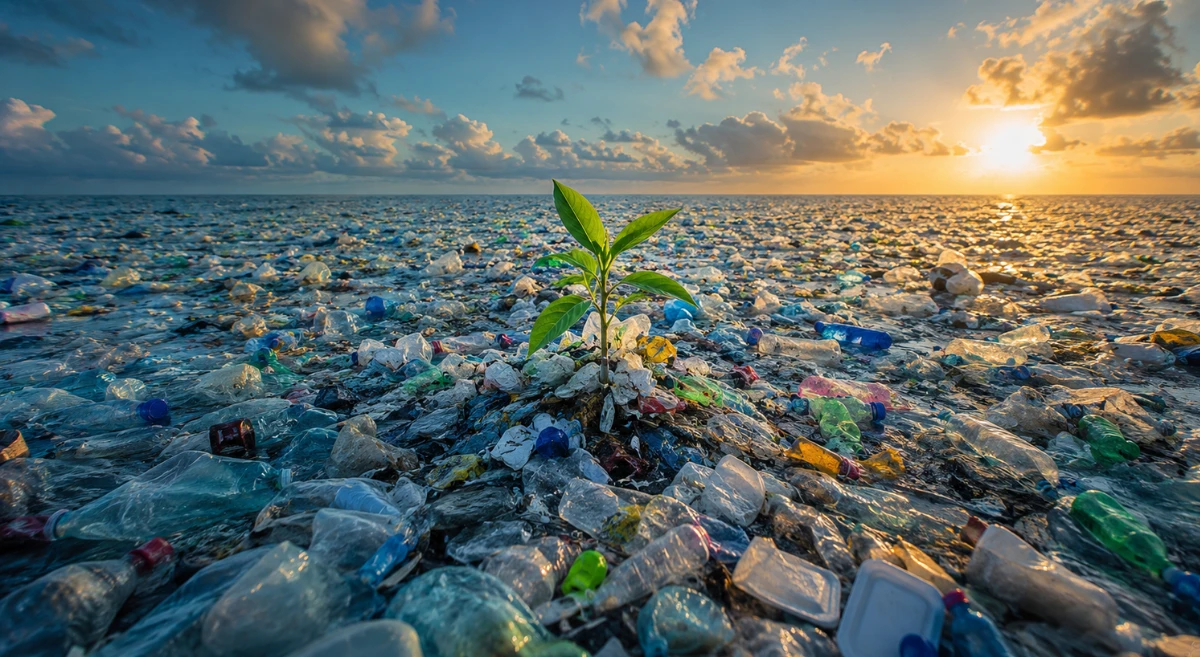
460 million tonnes of plastic a year. And we've recycled just 9% of it.
World Environment Day 2025 sounded a global alarm on plastic pollution but with treaty talks stalling and production still surging, awareness alone won't be enough. Here's what the science demands next.
A Planet Wrapped in Plastic
On June 5th, from the volcanic shores of Jeju Island in South Korea, the world marked World Environment Day 2025 with a single, urgent message: #BeatPlasticPollution. Communities, civil society, businesses, and governments across the globe gathered under this theme, with official celebrations held in Jeju Province hosted jointly by the Republic of Korea and the UN Environment Programme (UNEP). UNEP
But beyond the banners and pledges, a harder truth was taking shape. More than 460 million metric tonnes of plastic are produced every single year, of which an estimated 20 million end up polluting our environment. Plastic has been found in glaciers, in deep-ocean trenches, in the blood of newborns, and in the air above cities. The crisis is not on the horizon. It is already here. World Economic Forum
Why Plastic Is a Climate Issue
It's tempting to think of plastic as a waste problem something to be picked up off beaches and sorted into bins. But the science tells a different story. More than 400 million tonnes of plastics produced annually are made almost entirely from fossil fuels, making plastic manufacturing a major contributor to the greenhouse gas emissions driving climate change. Petrochemicals, including plastics, are projected to drive more than one-third of the increase in global oil demand by 2030. Human Rights Watch
The lifecycle of plastic — from extraction to production to disposal is a climate crime in slow motion. Ending plastic pollution, therefore, is not separate from fighting the climate crisis. It is part of it.
The Treaty That the World Urgently Needs
Since 2022, countries have been negotiating what could become the most significant environmental agreement since the Paris Accord: a legally binding global plastics treaty. World Environment Day 2025 arrived exactly two months before countries were due to resume negotiations toward this landmark treaty. UNEP
The stakes could not be higher. Global plastic waste is expected to reach 1.7 billion metric tonnes by 2060, costing a cumulative $281 trillion by some estimates. Yet progress has been painfully slow. The latest round of talks, in August 2025, ended in gridlock, leaving the treaty's future deeply uncertain. World Economic ForumWorld Resources Institute
The fault lines are familiar: a majority of nations pushing for ambitious, binding cuts to plastic production — including the 75-member High Ambition Coalition versus a smaller bloc of petrochemical-producing countries resisting production caps. Of the world's plastic waste generated annually, only around 9% is recycled. Fifty percent ends up in landfills, and 19% is incinerated with the remaining 22% leaking directly into the environment. This is not a recycling problem. It is a production problem. World Resources Institute
Who Bears the Burden
As with every dimension of the environmental crisis, plastic pollution does not distribute its harm equally. Communities in the Global South — with less formal waste infrastructure, higher rates of open dumping, and greater dependence on single-use plastics — face disproportionate exposure. Plastic pollution contaminates soil, blocks water sources, and harms ecosystems — driving displacement and forcing people to move in search of safer, more sustainable living conditions. International Organization for Migration
Informal waste workers — many of them women handle toxic materials daily with little protection. The health impacts compound across generations.
What a High-Ambition Treaty Could Actually Do
The good news: the solutions exist, and the numbers are striking. Research models show that a package of four coordinated policies — working across the full plastic lifecycle could reduce mismanaged plastic waste by up to 91% by 2050 and cut associated greenhouse gas emissions by one-third. berkeley
Achieving a 40% reduction in plastic pollution by 2040 from 2025 levels is within reach but it will require eliminating subsidies for plastic production, pausing new infrastructure in markets with excess capacity, and strengthening policy frameworks across the board. The Pew Charitable Trusts
The technology, the policy models, and the scientific consensus all point in the same direction. What is lacking is the political will to match the moment.
What You Can Do Right Now
Change does not wait for treaties. Every person, community, and business has a role to play: refuse single-use plastics wherever alternatives exist; support brands with verified (not just pledged) plastic reduction commitments; and pressure elected representatives to back an ambitious global treaty.
The 2025 World Environment Day slogan - "Shared Challenge, Collective Action" reflects exactly this: no single actor can solve plastic pollution alone, but together, the solutions are achievable. Un
Share this with someone who needs to know : because the plastics treaty negotiations may be happening in conference rooms, but the pressure to get them right must come from all of us.